
CQRS and event sourcing, from the beginning
Start with a familiar application. An accounts table stores one row per bank account. An endpoint
loads a row, checks that the balance covers a withdrawal, changes balance, and saves it. Another
endpoint loads the same row with the owner, every transaction, and pending transfers to render a
statement.
That design is often the right place to begin. It becomes difficult when the model used to make decisions and the model used to answer questions are pulled in different directions.
Motivation: CQRS is a response to incompatible change pressures, not a goal by itself. Separate the models when keeping them together makes either business decisions or queries harder to express.
One model is doing two jobs
Consider a withdrawal.
The decision needs a small, precise set of facts: whether the account is open and what its balance is. It must protect the rule that a withdrawal cannot overdraw the account, even if two withdrawals arrive at the same time.
The statement needs a different shape: the owner's name, every deposit, withdrawal, and transfer with its memo, and the balance after each one. A list of large transfers and a monthly report need still other shapes.
Adding every query field and relationship to the decision model makes the rules depend on a large object graph. Shaping every query around the decision model produces joins and transformations on every read. The two jobs change for different reasons.
CQRS separates those responsibilities
CQRS means Command Query Responsibility Segregation.
- The write model receives commands, protects business rules, and records outcomes.
- The read side answers queries from data shaped for those queries.
This does not mean every application needs two services or two databases. The separation is about models and responsibilities. A small system can run both sides in one process and one database while keeping the code and data flows distinct.
| Write side | Read side |
|---|---|
| Accepts commands | Accepts queries |
| Shaped around invariants: rules that must hold after every accepted command | Shaped around screens and consumers |
| One consistency boundary per decision | Joins and duplicates data freely |
| Produces events | Consumes events |
| Rejects invalid changes | Returns available information |
Commands and events describe different moments
A command is a request: Withdraw 60. It is named in the imperative because the outcome is not
known yet. The system can reject it.
An event is a recorded outcome: Withdrawn 60, or a reply that is not stored, such as
Rejected "Insufficient funds". Withdrawn is named in the past tense because the decision has been
made.
Keeping the types separate prevents a request from being mistaken for a fact. It also makes the domain decision visible:
Withdraw 60 + current account state
    -> persist Withdrawn 60
    -> or reply Rejected "Insufficient funds"
FCQRS puts the decision inside an aggregate. The aggregate does not return a mutated database row. It returns an action describing the event outcome.
Event sourcing records change instead of overwriting it
CQRS and event sourcing are separate ideas. You can use different command and query models while storing only current state. You can also event-source a model without creating several read models. FCQRS deliberately combines them.
With ordinary state storage, an update replaces balance = 100 with balance = 70. The database
retains the new value but not the deposits and withdrawals that produced it.
With event sourcing, the journal appends facts:
1  Opened "Alice"
2  Deposited 100
3  Withdrawn 30
Current state is derived by folding those events in order:
empty
  |> apply Opened "Alice"    = open, balance 0
  |> apply Deposited 100     = balance 100
  |> apply Withdrawn 30      = balance 70
The fold is an ordinary deterministic function. Given the same initial state and event sequence, it must always produce the same result. Recovery relies on that property.
Follow one request through the system
An FCQRS request takes this path:
- The client creates a correlation ID and sends
Withdraw 30to the account aggregatealice. - The aggregate loads its current state, recovering from stored events if necessary.
- Its decision function checks the command against that state.
- If allowed, FCQRS appends
Withdrawn 30to the journal. - The aggregate folds the event into its in-memory state and publishes it.
- One or more projections consume the event and update read models.
- The client queries the read model, optionally after waiting for the required projection.
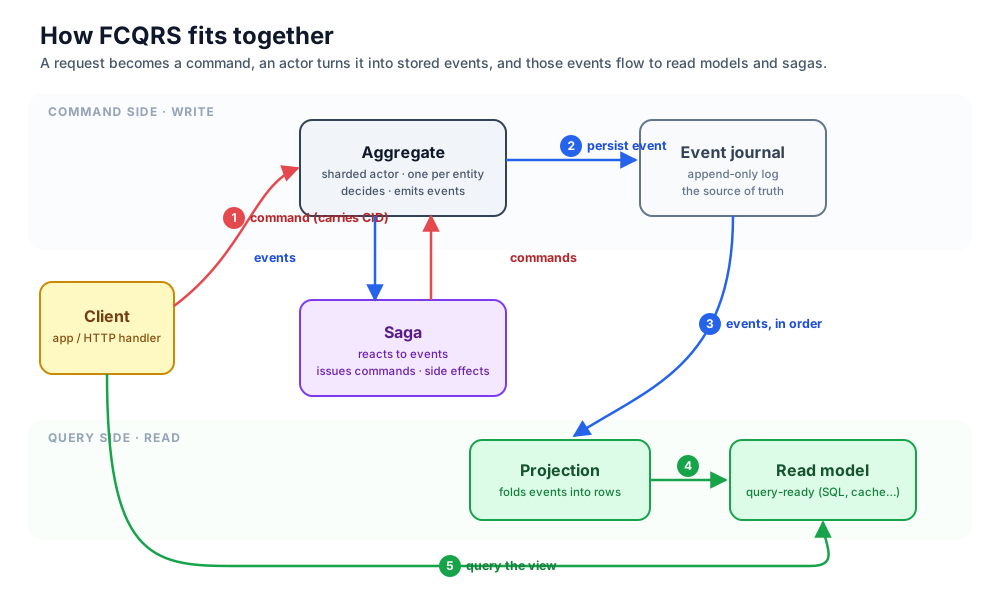
The write side never exposes its internal state as the query contract. Both sides agree on the facts, not on one shared object graph.
What the history makes possible
The journal supports more than auditing.
- An inactive aggregate can recover its current state by replaying its events.
- A corrected projection can rebuild a read model from the original facts.
- A new read model can answer a question that did not exist when the events were recorded.
- Tests can describe a decision as “given these past events, when this command arrives, expect this outcome.”
History also creates responsibilities. Persisted event shapes become long-lived contracts. Storage grows with the number of changes. Rebuilds and migrations must be rehearsed. Sensitive data cannot be treated as casually deletable once it is copied into an append-only history.
What this architecture does not imply
CQRS does not require microservices, a message broker, or one database per model. Event sourcing does not make every operation globally consistent. FCQRS serializes decisions inside one aggregate, while projections and cross-aggregate workflows remain asynchronous.
Use this model when history, concurrency rules, recovery, or multiple query shapes justify the extra moving parts. For behaviour that is only create, read, update, and delete, a conventional application is usually clearer.
Check your understanding
For one feature in your domain, write down the command, the minimum state needed to decide it, the persisted event, and two different queries derived from that event. If the decision state and query shapes are identical and the history has no value, CQRS and event sourcing may not earn their cost.
Next, learn how aggregates protect one decision boundary. The tutorial builds this bank one step at a time.