
The read side: from facts to answers
The journal is excellent at preserving what happened. It is a poor shape for most questions a user asks.
A statement page wants one query-ready result: the owner, every deposit, withdrawal, and transfer with its memo, and the balance after each. Loading the account and scanning its event history for every page request would make queries slow and couple the user interface to write-side internals.
The read side exists to turn stored facts into useful answers ahead of time.
Motivation: A projection pays the transformation cost once as events arrive. Queries can then read the shape they need directly instead of rebuilding histories and joining write-side state on every request.
Projection and read model are different things
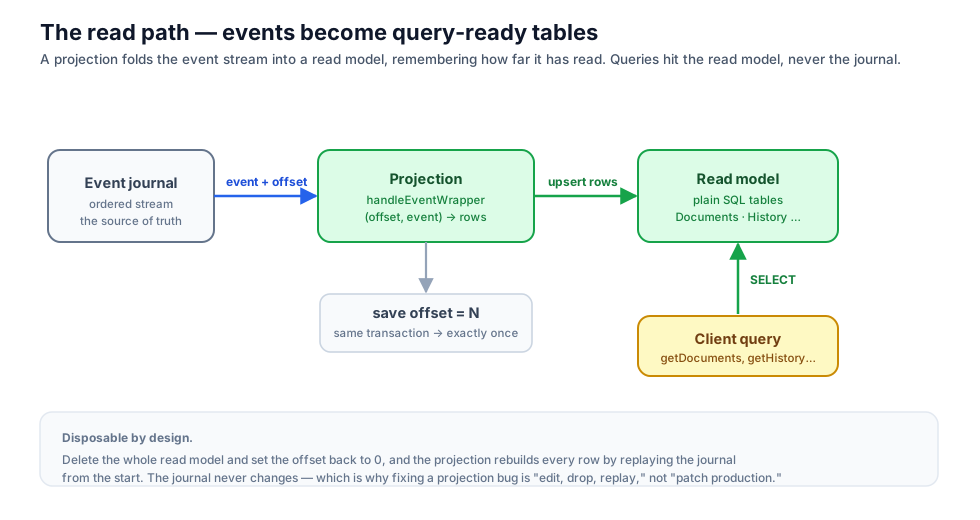
A projection is the event-handling process. A read model is the data it produces.
For example:
Opened           -> insert a statement row with a balance of 0
Deposited        -> insert a row, balance = previous balance + amount
TransferSent     -> insert a row, balance = previous balance - amount
The read model may be a SQL table, document, search index, graph, or cache. Its shape follows a query, not the aggregate state or event schema. It may duplicate names and totals if that makes reads direct and understandable.
Several projections can consume the same event. TransferSent might update a statement, a list of
large transfers, a fraud review queue, and a monthly report. Those read models can evolve
independently because they share facts rather than one schema.
Track progress per aggregate
A projection records how far it has handled each aggregate's events: the version of the last event it handled for that account. After a restart, it continues after that version.
alice   1 Opened   2 Deposited 100   3 Withdrawn 30    handled through version 2
bob     1 Opened                                       handled through version 1
The projection handles Alice's version 3 next. It does not ask each aggregate for current state. The journal is the source; the handled versions are the projection's bookmarks.
Motivation: The journal also numbers all events in one sequence, but a database that runs several writes at once gives a write its number when the write starts, and shows it when the write commits. A slow write can appear after higher-numbered ones. A projection that only remembered "handled through number 42" would pass over it and never handle it. An aggregate's versions have no such holes: one actor stores them one after another, so a projection that follows each aggregate's versions cannot skip an event.
Order across aggregates comes from the journal's numbers. Each time a projection reads the journal, it applies the events it found in the order the journal numbered them, so a handler can read rows that earlier events of other aggregates wrote. On SQLite, which runs one write at a time, that is the order the events were written. On PostgreSQL, a slow write that commits after higher-numbered ones is applied in a later read, after them, so a handler there must not depend on which aggregate's event arrives first.
A projection keeps its progress in one of three places:
- in memory, so it reads the whole journal again each time it starts, for a read model kept in memory;
- in the journal database under the projection's name, so it resumes where it stopped;
- in the read model's own database, committed together with each read-model change, which is what the transactional projection in the tutorial does.
The transaction boundary creates reliable progress
For a SQL read model, handle one event like this:
- Begin a database transaction.
- Apply the read-model insert, update, or delete.
- Store the aggregate's new version as the projection's progress, in the same transaction.
- Commit.
If the process stops before commit, neither change is durable and the event is retried. If commit succeeds, both the data and progress are durable. This prevents the two dangerous split states:
- data changed but progress did not advance, so a non-idempotent update runs twice;
- progress advanced but data did not change, so the event is skipped forever.
Within one transactional store, this produces one committed update per event. If a projection writes to SQL and a search service, those systems do not share the transaction. A projection that stores its progress under a name stores it after its handler returns, so a crash in between hands the same event to the handler again. The handler must then use idempotency, an outbox (staging the external write in the local transaction and relaying it afterwards), or another explicit coordination design.
Event order is part of the model
A projection should make invalid histories visible. If Deposited arrives for an account whose
Opened the projection never saw, silently inventing a partial row hides a broken contract or rebuild. Failing the projection exposes the
problem at the event that caused it.
Handlers should also define how repeated or superseded facts behave. Committing progress with the data prevents normal repeats in one store, but rebuild tools, migrations, or external writes may still benefit from idempotent operations keyed by event identity.
Queries use only the read model
Application queries do not load aggregate actors or inspect the journal. They read the structure created for them. This keeps query latency and indexing independent from write-side recovery and business rules.
A read model is allowed to be stale for a short time. The aggregate commits first; the projection commits later. This is eventual consistency. It is not lost data, but it changes what the caller may observe immediately after a command.
Read your own write when the interaction needs it
Some interactions can redirect immediately and allow the page to catch up. Others must show the new result before replying. FCQRS carries a correlation id from the command to its event, so an active caller can subscribe to that id before sending and wait until the required projection publishes the matching event. Correlation IDs and read-your-writes develops the full request flow: the subscribe-before-send ordering, deferred replies that skip the wait, and the timeouts that bound it.
Read models are disposable, rebuilds are not casual
Because every read-model value is derived from retained events, it can be rebuilt:
- stop or isolate the live projection;
- create or clear the target schema;
- give the projection a new name, so it starts from the first event;
- replay and monitor failures;
- validate counts and representative queries;
- switch traffic to the rebuilt model.
“Disposable” means the journal can reproduce the data. It does not mean deleting a production view is risk-free. Large replays take time, old events must remain deserializable, and a broken projection may fail halfway through. A side-by-side rebuild often provides the safest rollback.
Design one read model per question
Start from a consumer and a query, not from the event types. Write the result shape the consumer would like to receive in one read. Then determine which events create and update it, which fields need indexes, and how the projection handles missing or out-of-order facts.
The tutorial's statement puts these ideas into a running program. Use Add a projection, Read your writes, and Rebuild a read model for focused implementation recipes.