
Concepts: build the mental model
These pages explain FCQRS decisions and guarantees. Start with the tutorial for code you can run, or choose a question below.
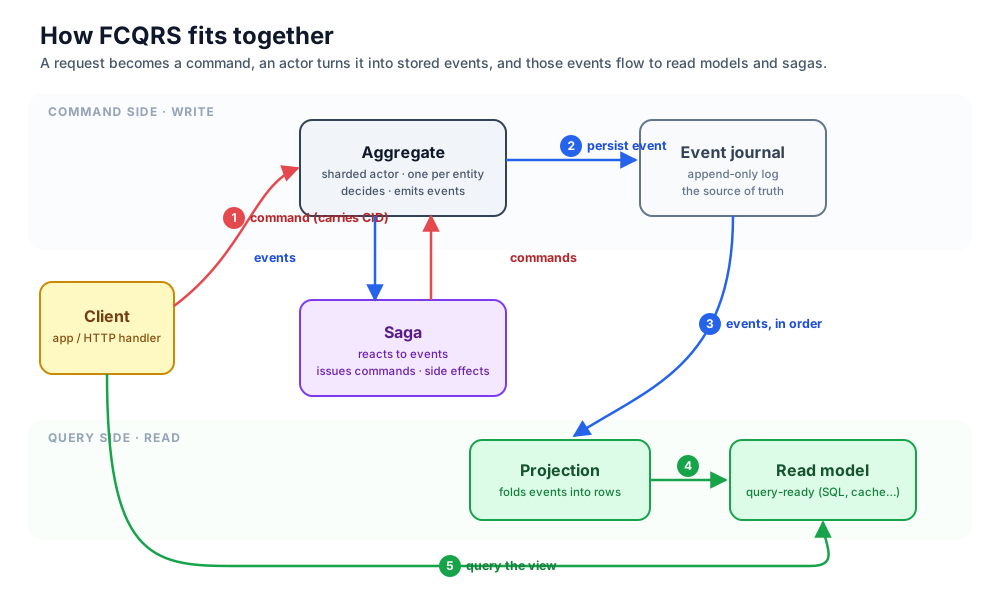
Start with four questions
Every FCQRS design can be approached through four questions:
- What decision is being requested? A command names the caller's intent, such as
Withdraw 60. - Which information must be consistent for that decision? That information belongs inside one aggregate boundary.
- What fact should be recorded if the decision succeeds? An event such as
Withdrawn 60becomes part of the permanent history. - What information must callers query? A projection turns the stored facts into a read model shaped for that question.
If one decision needs work owned by several aggregates, a saga coordinates the steps without merging their state.
The vocabulary, in dependency order
- A command asks the system to do something. It may be accepted or rejected.
- An event records an outcome that has already happened.
- An aggregate owns the state and rules required to decide commands for one identity.
- The journal is the append-only history of persisted events.
- A fold rebuilds current aggregate state by applying those events in order.
- A projection consumes journal events and updates query-ready data.
- A read model is the data produced by a projection for a particular query or screen.
- A projection's progress records the last version of each aggregate it has handled.
- A saga stores the progress of work that crosses aggregate or service boundaries.
- A correlation id ties one request to the commands, events, saga steps, and projection signal it causes.
- A snapshot is a recovery checkpoint. It shortens replay but does not replace the journal.
- Passivation stops an inactive actor without deleting its journaled history.
These terms describe different responsibilities. In particular, aggregate state, stored events, and read-model rows are not three names for the same data.
Choose by the question you are asking
| Question | Read |
|---|---|
| Why separate decisions, history, and queries? | CQRS and event sourcing |
| Where should one business rule live? | Aggregates and the write side |
| How do projections, their progress, and query models differ? | The read side |
| How does one request wait for the correct projection? | Correlation IDs and read-your-writes |
| How do independent owners coordinate after failures? | Sagas |
| What do defer, snapshot, and passivation each do? | Deferring, snapshots, and passivation |
| What is durable at each point in the complete flow? | Consistency and recovery |
| Why did my process stop, and what should I do about it? | When FCQRS stops the process |
| How should C# messages cross the persistence boundary? | C# interop and serialization |
How to use a concept page
Start with a concrete question from your application. Read the matching page, identify the guarantee and its boundary, then return to your design. Use Apply only when you are ready to turn that decision into code or configuration.